



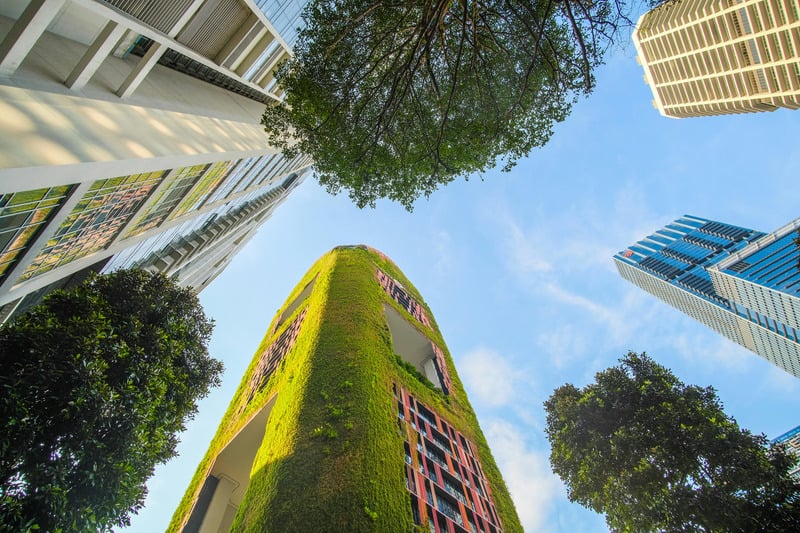
Here are some landmarks that were built with the environment at heart.
- 20 Fenchurch Street, London, UK
20 Fenchurch Street, a staple of the London skyline, is better known by its nickname, the ‘Walkie Talkie’.
The 1,601m-tall office building is home to the famous Sky Garden – a green oasis and observation deck offering a 360° view of the city.
But the garden, populated by a variety of Mediterranean and South African species, isn’t the only ‘green’ feature in the building.
Others include:
the largest green wall in the UK
roof-mounted solar panels
sustainably sourced concrete and structural steelwork
96.4% of construction waste was diverted from landfill, recycled, reused or recovered
a hydrogen fuel cell used for low carbon heating, cooling and electricity
- Eastgate, Harare, Zimbabwe
Eastgate is considered exemplary of sustainable construction due to its imitation of the natural world, or biomimicry.
Termites build skyscraper-like mounds that are ventilated via a complex arrangement of tunnels.
Like a chimney, when the air outside is cooler, warm air naturally vents from the top of the mound.
This in turn draws in cooler, fresh air in via the system of tunnels, regulating the temperature.
Eastgate imitates these structures to provide fresh air and comfortable temperatures throughout the year.
It has also significantly reduced the building's energy use and carbon emissions.
3. CopenHill, Copenhagen, Denmark
CopenHill turns sustainability into fun, for underneath the multimodal sports centre lies a waste-to-energy power plant capable of converting 440,000 tonnes of waste into clean energy every year.
That’s about the same weight as 4,000 blue whales.
With cutting-edge technology, the plant provides electricity and district heating for 150,000 homes annually.
The building’s hiking and running trail also features a garden, which absorbs heat, reduces stormwater runoff and provides a home for birds, insects and flowers.
4. One Central Park, Sydney, Australia
The residential property was the first in Australia to combine living walls, where vegetation is planted directly on the walls, and green façades, with cascading plants that flow down from supports.
These vertical gardens cover 1,100m2 (about twice the area of a basketball court) and include 383 species.
The gardens were cleverly designed to ensure plants that thrive in sunlight were placed near the top of the building, while more delicate species inhabit the bottom.
An automated irrigation system takes reclaimed and treated sewage from the building to water the plants, with nutrients carefully monitored.
For original article, follow the link below: