



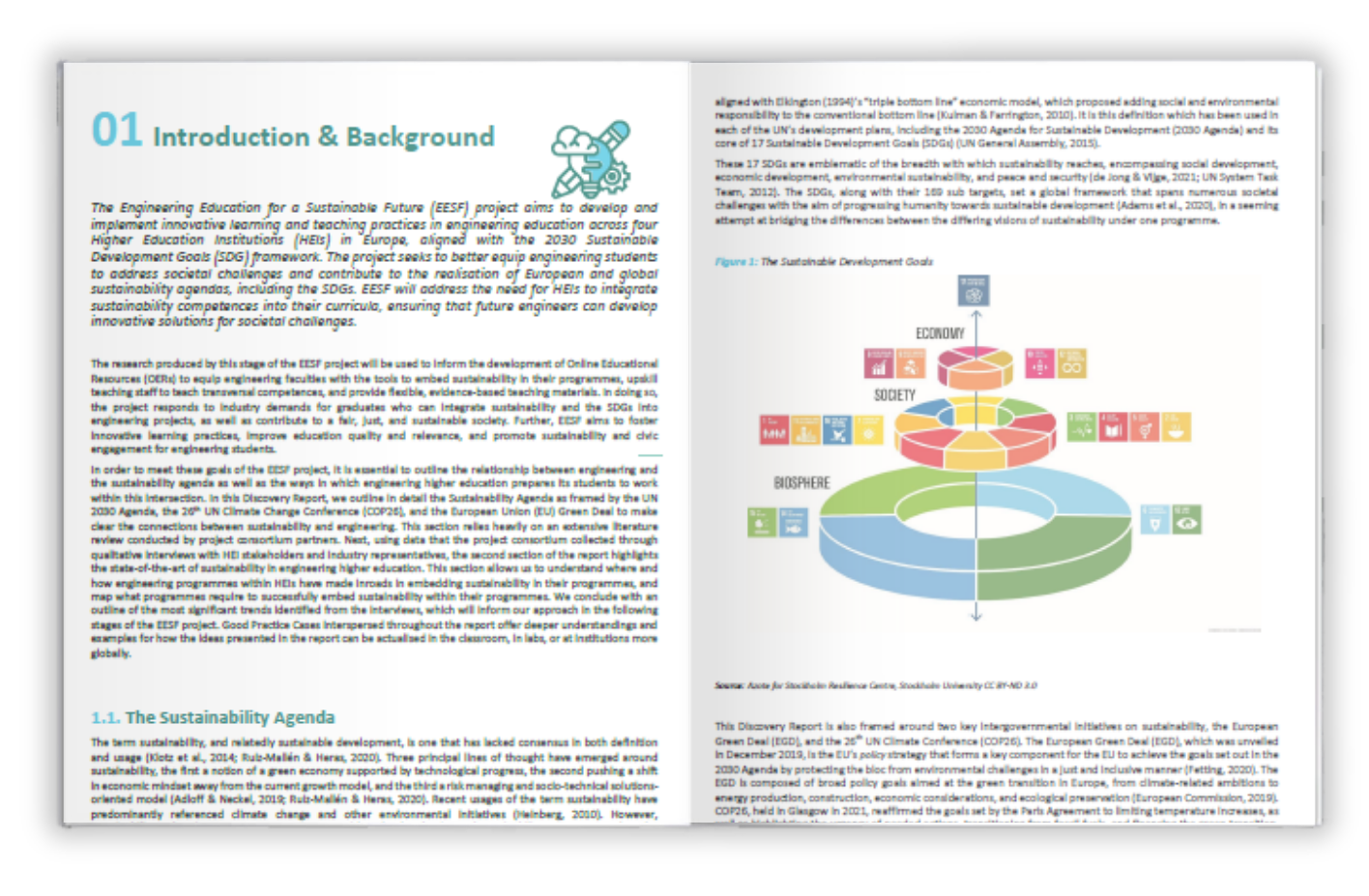
Based on the EESF Discovery Report (2025)
Every discussion of sustainability in engineering education eventually hits the same frustration: the gap between aspiration and practice. Everyone says it matters. Everyone agrees it should be embedded. But what does "embedded" actually look like in a working engineering programme?
The EESF Discovery Report provides an unusually concrete answer. Rather than staying at the level of frameworks and recommendations, the report documents specific approaches taken by partner institutions, Atlantic Technological University in Ireland, Institut Mines-Télécom Business School and other IMT-group schools in France, Universidad Politécnica de Madrid in Spain, and Instituto Politécnico do Porto in Portugal, among others. What follows is a tour through five of the most instructive good-practice cases, drawn directly from the report.
1. UPM: Embedding sustainability into the grading system
Some of the most effective interventions are also the simplest. At Universidad Politécnica de Madrid, the engineering department has integrated sustainability directly into its grading framework, ensuring that sustainability considerations account for at least 0.25% of a student's grade on the master's final project.
The percentage sounds trivial, but the mechanism is powerful. By tying sustainability to assessment, UPM signals unambiguously that this is core content, not a nice-to-have. Students allocating effort across a final project will, rationally, pay attention to the criteria they're graded on. Making sustainability one of those criteria forces engagement in a way that exhortation alone can't.
UPM has gone further at the institutional level. A sustainability delegate sits on the management team, advocating for sustainability across faculty and student activities. Significant investment has gone into energy efficiency and responsible consumption improvements on campus. The institution has established its Network of SDG Nodes — sustainability working groups inside each school, creating formal infrastructure that doesn't depend on individual enthusiasm.
2. ATU: Learning sustainability by doing sustainability
Atlantic Technological University in Ireland has leaned into experiential learning. The 'Design for X' challenge, focused on circular economy principles and sustainable product design, throws students into practical problems rather than theoretical ones. Energy conservation projects, material selection challenges, and collaborative engineering tasks put sustainability principles to work in contexts students can actually see and measure.
ATU's curriculum also teaches students to conduct thermal bridge assessments, moisture risk analyses, and carbon counting using specialised software, skills that map directly onto what Irish industry is asking for in graduates working on sustainable construction and retrofitting. For programmes where the discipline naturally lends itself (construction, energy, civil engineering), this kind of tight alignment between curriculum and industry need is achievable without reinventing the programme.
Faculty CPD has also been a focus. The report notes that ATU supports sustainability through continuing professional development offerings and funding for initiatives like a climate action leadership training programme,even if these tend to operate in an ad-hoc rather than systematic fashion.
3. P. Porto: Service learning and community engagement
Instituto Politécnico do Porto has built sustainability into its engineering programmes through service-oriented learning projects that engage real communities with real problems. Waste recovery, sustainable product design, agricultural waste management, students work on projects that produce outcomes beyond a grade on a transcript.
The institution's research groups, including CIETI and GRAQ, extend this by involving students in ongoing sustainability research. This creates a pipeline from classroom to research to industry, with students picking up both technical and transversal skills along the way.
P. Porto's institutional commitments back this up. The institution is a signatory to the Portuguese Pact for Plastics and the Porto Climate Pact, participates in sustainable campus networks, and has established its own P. Porto Commission for Sustainable Development to manage sustainability across operations. It was recognised as an exemplar for sustainability initiatives during the UN's 75th anniversary, a reminder that what happens inside engineering programmes is reinforced by what happens at the institutional level.
4. École des Ponts ParisTech: Competency frameworks and foresight education
École des Ponts ParisTech has taken a structured, framework-based approach, aligning its competency development with UNESCO's SDG competency framework and the Bologna Process. Rather than leaving sustainability to individual lecturers or modules, the institution has built sustainability competencies into the fabric of its programmes.
Particularly interesting is the institution's emphasis on foresight education, teaching students to think long-term, anticipate future challenges, and integrate stakeholders early in decision-making. This complements the systems thinking and multidisciplinarity that the EESF research identifies as critical mindsets.
Mentorship is another feature. Students at École des Ponts ParisTech are paired with experienced professionals who offer guidance on how sustainability integrates into real-world engineering projects. This kind of direct exposure to industry practice builds both understanding and networks, two things that matter for graduates entering sustainability-focused roles.
5. Université de Technologie de Troyes: Real projects for real clients
The Université de Technologie de Troyes in France takes the project-based approach further than most. Students work on sustainability challenges posed directly by local city halls, associations, and companies, real clients with real problems, not simulations.
The effect on student motivation, according to the report, is substantial. When students see that their work might actually be implemented, or will at least be taken seriously by external stakeholders, engagement shifts. The focus moves from exam-oriented learning to impact-oriented learning. Students encounter the genuinely messy interdisciplinary nature of sustainability work, technical challenges entangled with regulatory constraints, community concerns, and economic realities.
UTT also emphasises understanding human behaviour and organisational sociology, particularly in crisis or transition situations. This is an unusual addition to an engineering programme and reflects a recognition that sustainability work requires more than technical problem-solving, it requires navigating the human systems in which technical solutions get (or don't get) adopted.
What these cases have in common
Several patterns cut across the good-practice examples:
Institutional frameworks matter. UPM's Network of SDG Nodes, P. Porto's Commission for Sustainable Development, École des Ponts ParisTech's adoption of UNESCO competencies ,each represents structural commitment, not individual effort.
Assessment drives behaviour. Wherever sustainability has been integrated into grading, assignments, and graduation criteria, student engagement increases. Wherever it remains optional or adjacent, engagement wobbles.
Industry partnerships are central. The strongest examples feature real projects with real external partners, producing the kind of applied experience that industry repeatedly says it wants to see in graduates.
Service learning creates multiplier effects. Projects that benefit communities, not just students, tend to build both technical competencies and the civic sensibility that sustainability ultimately requires.
Staff capability underpins everything. CPD, mentorship, and explicit institutional support for faculty development appear in every case. No programme embeds sustainability well while its faculty feel unprepared to teach it.
What other institutions can take from this
Not every HEI can replicate every example. Institutional contexts differ, funding differs, national regulatory frameworks differ. But the core lessons transfer:
Find one concrete way to integrate sustainability into assessment. Find one live industry or community project that students can contribute to. Find one piece of infrastructure, a committee, a working group, a dedicated role , that gives sustainability organisational weight. And invest in faculty capability, because no amount of curriculum design compensates for lecturers who don't feel equipped to deliver it.
These aren't revolutionary moves. They're the visible, practical steps that distinguish institutions doing this well from institutions talking about doing it. The EESF Discovery Report's case studies make clear that the gap between the two groups isn't mysterious, it's a matter of sustained choices, repeated over time, at multiple levels of the institution.
The full Discovery Report, with detailed case studies, is available at www.eesfproject.eu.