



Based on the EESF Embedding Sustainability Competences Research Report (2025)
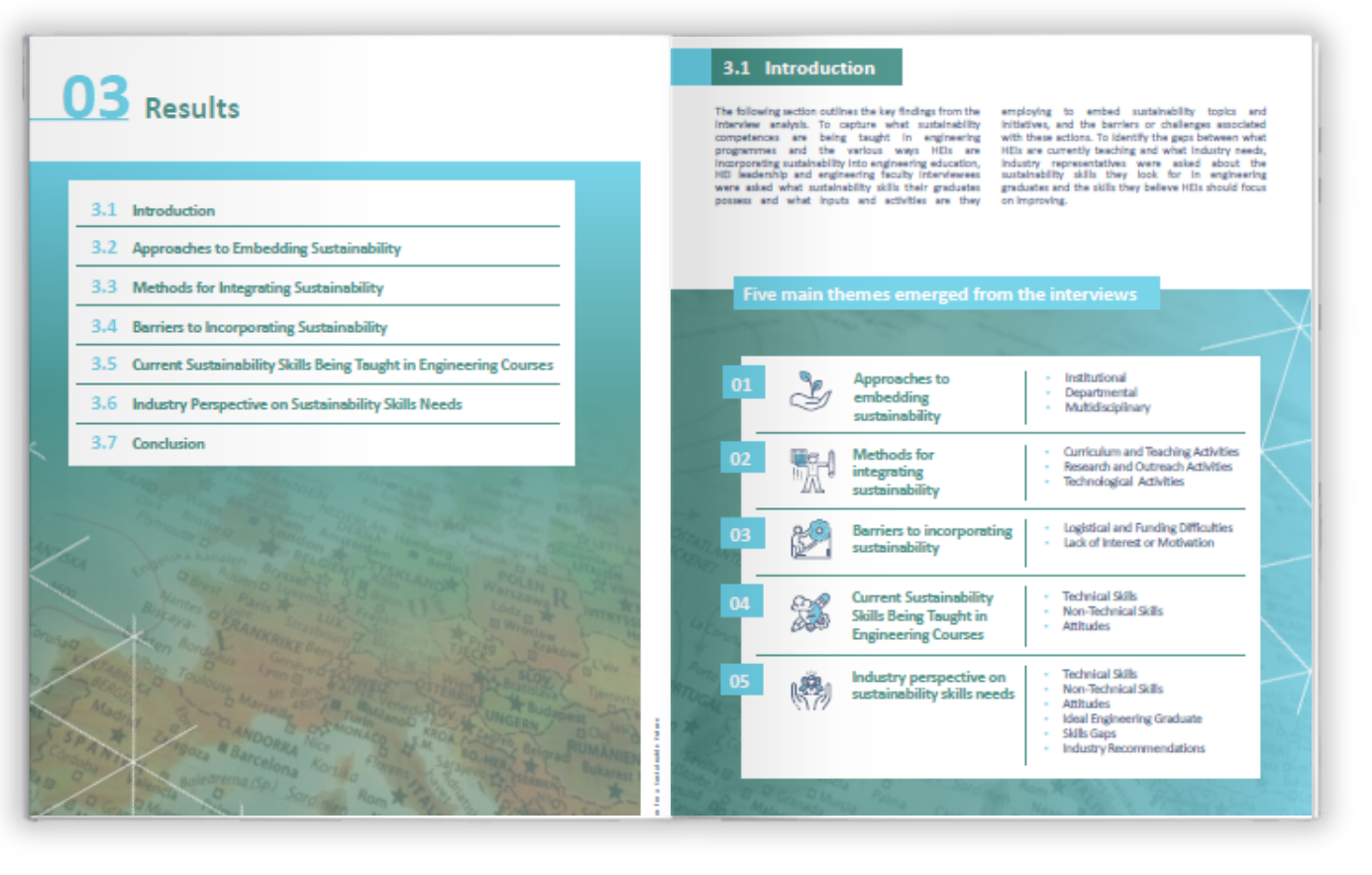
Talk to any engineering dean in Europe and you'll hear broad agreement that sustainability belongs in the curriculum. Look at what's actually happening inside lecture halls, though, and the picture is far more uneven. The EESF research project set out to understand why. After 53 interviews across Ireland, France, Spain, and Portugal, a clear set of barriers emerged, and, encouragingly, some practical responses to them.
Barrier one: money and time
The most frequently cited obstacles aren't philosophical. They're logistical. Faculty pointed to a lack of funding for training, for curriculum redesign, and for on-campus sustainability initiatives like energy efficiency upgrades and carbon accounting systems. They pointed to curricula that are already stuffed full, with highly specialised engineering modules that resist modification. And they pointed to time, the perennial complaint that teaching staff simply don't have the bandwidth to overhaul what they teach.
These constraints compound. A lecturer who wants to redesign a module to embed life-cycle assessment needs time to learn LCA themselves, time to build new teaching materials, and institutional permission to change an accredited programme. Remove any one of those and the redesign stalls. Earlier research by Blanco-Portela and colleagues (2017) and Leal Filho and colleagues (2018) had already flagged these same barriers, the EESF findings confirm that five years on, little has changed.
Barrier two: motivation (or the lack of it)
The second barrier is subtler and, in some ways, harder to fix: people aren't always motivated to change.
On the faculty side, competing priorities and differing pedagogical views make revising course material difficult. Not every lecturer believes sustainability belongs in their specific module. Some see it as an add-on that dilutes technical content. Others simply don't feel expert enough to teach it, one French teacher-researcher, quoted in the related EESF Discovery Report, captured a common anxiety: teaching sustainability without deep subject expertise risks turning lectures into subjective debates, which in turn prevents students from forming their own informed views.
On the student side, the research found that not every undergraduate arrives with strong convictions about sustainability. Some are engaged and passionate; others are there to pick up a technical qualification and get a job. This variable enthusiasm can blunt the impact even of well-designed curriculum revisions.
Barrier three: institutional inertia
The third barrier is the one institutions least like to talk about: themselves. Curriculum rigidity, slow governance, and organisational silos all slow the integration of sustainability. Research by Serafini and colleagues (2022) found that department heads often lack the authority to drive institution-wide changes, while curriculum structures designed for a different era struggle to accommodate the transdisciplinary nature of sustainability topics.
The EESF findings mirror this. Institutions that have established sustainability frameworks, committees, offices, dedicated roles, can implement change systematically. Institutions without such frameworks tend to integrate sustainability in fragmented ways: an isolated module here, an occasional project there. The difference in outcomes is significant.
Responses that appear to work
The research didn't just catalogue problems. It also surfaced approaches that genuinely move the needle.
Institutional frameworks beat individual heroics. Universidad Politécnica de Madrid's Network of SDG Nodes, formal sustainability working groups inside each school, provides infrastructure for sustainability work that doesn't depend on any one champion. Previous research by Mader and Rammel (2015) and Eppinga and colleagues (2019) had already shown that institutions with whole-institution sustainability strategies contribute more meaningfully to the SDGs than those without. The EESF interviews confirmed this pattern.
Staff training is the linchpin. Academic literature and the interview data both point to the same conclusion: faculty engagement requires faculty capability. Lecturers need CPD opportunities, workshops, and certifications focused on sustainability content and pedagogy. Where budgets don't allow for this, external speakers and guest lecturers can partially fill the gap, several interviewees described bringing in industry experts to cover specific sustainability topics.
Multidisciplinary collaboration dismantles silos. Sustainability challenges don't respect departmental boundaries, so curricula shouldn't either. Interdisciplinary projects that draw on engineering, business, environmental science, and social sciences produce the well-rounded graduates industry says it wants. They also expose students to the diverse perspectives needed to address multiple SDGs simultaneously.
Project-based and experiential learning shift the dynamic. Internships, work placements, and live industry projects give students experience that lectures can't. The Université de Technologie de Troyes, for example, has students tackle real sustainability challenges posed by local city halls, associations, and companies, shifting the focus from exams to tangible impact.
The student-led angle
One low-cost recommendation that surfaced repeatedly is worth highlighting: encourage student-led sustainability initiatives. Clubs, organisations, and student-run projects focused on sustainability challenges can dramatically increase engagement without requiring large institutional investment. Pair this with recognition, awards, funding for outstanding projects, mentorship connections, and you build a virtuous cycle where student enthusiasm drives curriculum demand rather than the other way around.
The honest bottom line
The barriers to embedding sustainability in engineering education are real, but they aren't mysterious. They're about money, time, motivation, and institutional design. Every one of them is addressable if leadership is willing to make the choice. The EESF research makes clear that the gap between institutions doing this well and institutions doing it poorly isn't about resources alone, it's about whether sustainability has been made a strategic priority or left to individual goodwill.
That choice, ultimately, is the one every HEI leader needs to make. The climate challenge doesn't pause while curricula catch up.
The full Research Report is available at www.eesfproject.eu.