


Based on the EESF Embedding Sustainability Competences Research Report (2025)
The question behind the research
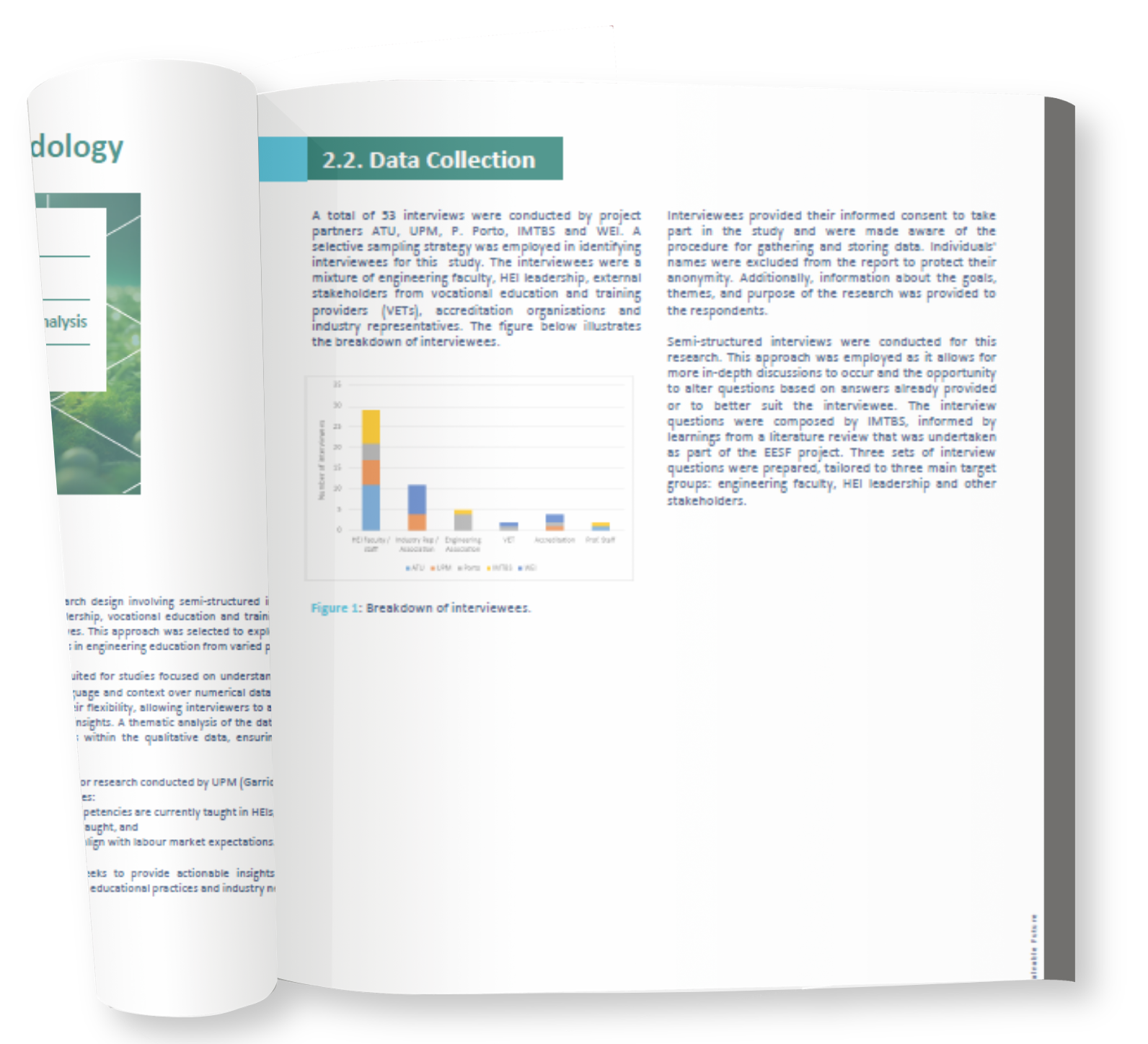
If you asked a European engineering dean, a lecturer, and a hiring manager the same question "are we training engineers ready to tackle the climate challenge?" would you get the same answer? The Engineering Education for a Sustainable Future (EESF) project decided to find out. Over the course of 2024, partners from Ireland, France, Spain, and Portugal sat down with 53 professionals, university leadership, engineering faculty, vocational trainers, accreditation bodies, and industry representatives, to map exactly how sustainability is (and isn't) finding its way into undergraduate engineering programmes across Europe.
The short version of what they found: everyone agrees sustainability matters. Almost no one is teaching it the same way.
Progress is real, but uneven
A decade ago, sustainability in engineering education was largely a niche concern. That has genuinely changed. Every single institution interviewed was doing something to embed the UN Sustainable Development Goals (SDGs) into its engineering curricula. At Politécnico do Porto, Universidad Politécnica de Madrid, and Institut Mines-Télécom Business School, faculty described the SDGs as widely integrated across the institution. At UPM, this has gone so far as a Network of SDG Nodes, sustainability working groups embedded inside each school and faculty, with members of the engineering management team sitting on the decarbonisation committee.
But move down the road to other institutions and the picture shifts. At Atlantic Technological University in Ireland, faculty reported that while sustainability is integrated into courses, it isn't done consistently. Integration often depends on whether an individual lecturer happens to care about the topic. The research confirmed what earlier studies by Wyness and colleagues had suggested: institutions without a formal sustainability framework tend to bolt sustainability on as supplemental modules rather than weaving it through the curriculum.
Three levels where integration happens
The interviews revealed that sustainability gets embedded at three distinct levels, and the strongest programmes operate at all three simultaneously:
At the institutional level, leadership creates frameworks, committees, and funding streams. UPM's SDG Nodes network is one example. Another is the "Développement Durable – Responsabilité Sociétale et Environnementale" cross-disciplinary group at one French partner institution, which works across research, teaching, and administration on themes like decarbonisation, mobility, and energy sobriety.
At the departmental level, individual faculty members often do the heavy lifting. The research uncovered a recurring pattern: a single passionate academic championing sustainability, developing continuing professional development (CPD) courses, running research collaborations with industry. This is inspiring, and also fragile. When sustainability depends on one person's enthusiasm, it can evaporate the moment that person retires or moves on.
At the multidisciplinary level, institutions bring engineering students into dialogue with other faculties and external partners. Interviewees repeatedly pointed to benefits here: well-rounded graduates, richer learning, and the ability to address multiple SDGs at once rather than treating them as isolated targets.
How sustainability actually shows up in the classroom
The research catalogued a wide range of teaching methods currently in use:
Course curricula are being redesigned to weave sustainability into existing modules, from sustainable urban drainage to renewable energy, while some institutions have introduced first-year modules that explicitly introduce the SDGs. Project-based learning came up again and again, praised for building teamwork, communication, and presentation skills while forcing students to apply technical solutions to sustainability problems. Internships and work placements offer hands-on exposure that the classroom struggles to replicate. Hackathons and contests have been used to energise students around specific sustainability themes.
Beyond teaching, research projects and outreach play a supplementary role. UPM's participation in the CESAER association, a network of 58 universities globally, illustrates how institutional research commitments can reinforce classroom messaging. EU alliances such as EULiST connect academic work with society and businesses, extending sustainability beyond university walls.
Technology tools also feature: digital SDG badges and carbon accounting platforms like One Click LCA were specifically mentioned as resources being deployed to teach sustainability skills.
The uncomfortable finding
Here's where the research gets pointed. Industry representatives, the people who hire these graduates, were clear that a gap remains. Recent graduates arrive with strong theoretical knowledge but often can't apply it in real-world situations. They know the technical side of regulations but struggle with the bureaucratic realities, such as distinguishing between a regulation and a directive. And soft skills, particularly the ability to express an idea succinctly, need work.
One industry interviewee put it bluntly: rather than simply providing experience to graduates, they find themselves doing extensive training just to bring new hires up to the basic concepts needed for the work at hand.
What this means
The EESF research makes a case that's hard to argue with: European HEIs have moved beyond denial and into action on sustainability in engineering education. The question is no longer whether to embed it, but how to do so consistently, systematically, and in a way that produces graduates industry actually wants to hire.
That's a harder problem. It requires institutional frameworks rather than individual heroics. It requires faculty training and funding. It requires collaboration between HEIs and the companies that will employ their graduates. And it requires a shift in how we measure success, not just technical competence, but the ability to apply it to the complex, interconnected challenges the SDGs were written to address.
The full Research Report is available at www.eesfproject.eu.